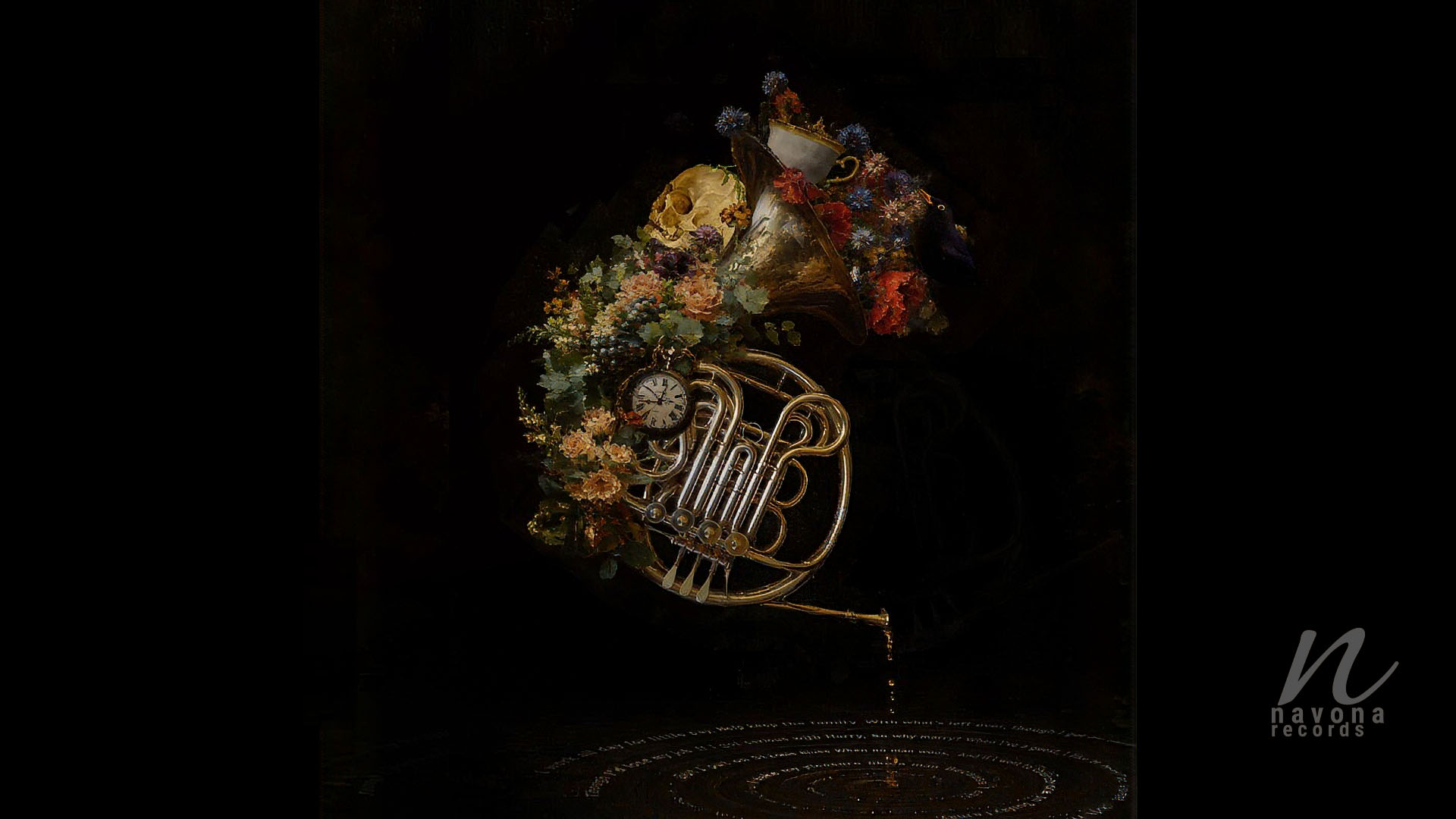
Composer David Jaeger’s THE HORN SPEAKS showcases evocative and narrative instrumental art songs for French horn. Each work is tailored to the artistry of Olivia Esther, whose expressive performance brings these deeply personal compositions to life with sensitivity, warmth, and emotional depth.
Today, David (DJ) and Olivia (OE) are our featured artists in “The Inside Story,” an interview series exploring the music and personalities of today’s composers and performers. Read on to learn how their initial creative partnership bloomed into THE HORN SPEAKS, and how they arrived on the final high note on the album…
What first sparked the idea for THE HORN SPEAKS, and when did you realize you wanted to build an entire album around that concept?
DJ: Meeting Olivia and discovering her uncommonly nuanced and expressive playing convinced me that she was an ideal soloist to write for. My practice of creating melodic settings of poetry that was meaningful to me found a particularly receptive artist in Olivia. We began a conversation about writing for the horn that inspired me to see the horn in a variety of musical situations with a wide range of expressive possibilities.
As the connection between Olivia and me grew, so did the canon of music I had created for her. We found there was so much variety within the repertoire we had built, we wanted to share it with the world. Working with Olivia on this project was pure joy, as her interpretations became more and more vivid.
What was it like writing music specifically for Olivia? Did you find yourself imagining her sound and personality as you composed?
DJ: Yes. Olivia’s approach to music is incredibly closely aligned with mine. We speak the same language in our respective music making. Writing for her creative style of interpreting is so very inspiring, I feel it brings the best out of me, because I know as I write that the message I’m seeking to communicate through my music will only be amplified in her playing.
Was there a particular piece on the album that was especially memorable or rewarding to write? What makes that one stand out to you?
DJ: The solos in the Gifts cycle based on David Cameron’s poetry were the first pieces I shared with Olivia, and since our conversation began with those, they remain particularly meaningful to me. However, when I started the Night Calls trios, her response was immediate and strong. She encouraged me to make it a set of three pieces, and the result was particularly satisfying. I could see, as I worked on them, that the horn trio is a wonderful ensemble, capable of so much expressive potential. When we put them together with Joyce and Stephanie we all felt an immediate sense of satisfaction.
What was your first reaction when David approached you with the idea for THE HORN SPEAKS?
OE: David first contacted me six years ago, asking if I would be willing to look through one of his unaccompanied works and offer my thoughts on whether it might suit the horn. I remember responding with immediate enthusiasm. It isn’t every day that a composer reaches out personally with an invitation to collaborate, and I was both honoured and intrigued. My reply, however, was not a straightforward “yes.” It was more of a “yes, but…” accompanied by a suggestion that I felt might strengthen the piece. Looking back, that was perhaps a rather bold response considering we had never met in person! To my delight, David met my feedback with equal enthusiasm, embracing the conversation and immediately asking if he could send more music my way. What began as a simple exchange of ideas soon grew into a rewarding creative partnership. It wasn’t until about a year into our collaboration that David casually, and somewhat cheekily, floated the idea of recording THE HORN SPEAKS. My reaction was a mixture of immense flattery and complete disbelief. I remember thinking, “Really? Is he sure he wants me?” Yet that combination of excitement, trust, and shared artistic curiosity ultimately became the foundation of this project.
Is there a piece on the album that feels especially personal to you, or that you particularly enjoy performing? What makes it special?
OE: I perform this work as an homage to my great-great-grandmother, Ella Shields, whose life and career resonate profoundly with the themes of the poem. Born in America but celebrated internationally on the British music hall and vaudeville stages, Shields became one of the most famous male impersonators of the early 20th century. She was best known for her iconic portrayal of “Burlington Bertie,” a role that challenged conventional ideas of gender and performance and made her a star throughout the United Kingdom and beyond. Yet beyond her public success was a woman navigating the often competing demands of family life and artistic ambition. Shields was not only a celebrated performer but also a wife and mother, balancing her responsibilities at home with a groundbreaking career on the stage. While I could say much more about her remarkable life and achievements, Home At Teatime captures, for me, the emotional landscape she may have inhabited: the tension of living between two worlds, the expectations placed upon her as a woman, and the freedom she discovered through artistic expression. In many ways, the piece is a reflection on courage: the courage to embrace one’s authentic self, to defy convention, and to pursue a life shaped not by expectation, but by truth. Through this work, I feel a deep connection to Ella’s legacy, and I am honoured to celebrate her story through music.
What was the recording process like? Were there any moments in the studio that surprised you or ended up taking the music in an unexpected direction?
OE: Recording can be a daunting experience, and I was especially aware of that going into this project, knowing that half of the album was for unaccompanied horn. Most brass players will tell you that we have a fairly limited window each day where we’re physically fresh and able to perform at our best. We don’t quite have the luxury of a pianist or violinist who can keep going for hours, taking endless retakes. So I knew I would need to be fully “on” for the recording, both mentally and physically.
We recorded over two days, and honestly, I’m still not entirely sure what took hold. Maybe it was sheer grit. Maybe it was my love of music. Maybe it was adrenaline. Whatever it was, as the sessions went on, I found myself feeling stronger and more confident rather than more tired. That was certainly a pleasant surprise.
The very last piece we recorded was Home at Teatime. The ending was originally written to finish on a mid-low written B-flat, but I was having trouble landing it with the kind of centred, resonant finish I was hearing in my head. While we were working through it, my partner and fellow horn player, Victor Prado, who also appears on the album, leaned over to David and casually said, “You know she’s a high horn player.”
David looked at me and asked, “Would you like to try it up the octave?”
My immediate thought was, Well, this could go very wrong. It was the end of the day, my chops had already put in a full shift, and asking for a high note at that point felt a little ambitious. But then I thought about the text. The final line of the poem is: “Because I can.”
There was something about those words that gave me a sense of optimism and resolve. It felt less like a line in a poem and more like a challenge. A little voice saying, Why not?
So I said, “Let’s try it.”
It took one take.
And that’s the final sound you hear on the album.