Long before synthesizers went mainstream, musicians at U of T were creating sounds that challenged the idea of what music could be
On a spring day in 1959, a panel truck pulled up to a converted house in downtown Toronto and a physicist named Hugh Le Caine climbed out. Behind him, loaded into the back of the vehicle, was a collection of objects that had never before been assembled in one place in Canada: oscillator banks, multi-track tape machines and custom-built electronic devices that Le Caine had spent years designing in his Ottawa laboratory. He had come to U of T’s St. George campus to help build something new.
What emerged from that delivery would become one of the earliest electronic music studios in the world – and one of North America’s most influential centres for musical experimentation.
The man who made it happen was Arnold Walter, then director of U of T’s Faculty of Music, who had grown convinced that music had become “imprisoned in its instruments.” Conventional instruments, conventional forms, conventional sounds – the whole apparatus of Western music, he believed, had largely stopped evolving a century earlier. Electronic music offered a way forward.
At the National Research Council in Ottawa, Le Caine had earned a reputation as a designer of experimental instruments, among them the Sackbut – a proto-synthesizer that predated the commercial Moog by almost two decades.
Walter was so taken with Le Caine’s devices that he initially tried to bring the inventor’s entire laboratory to Toronto. When that proved impossible, Walter did the next best thing: he invited Le Caine to help him build a new one. By January 1959 they were deep into planning. By June, the studio was open.
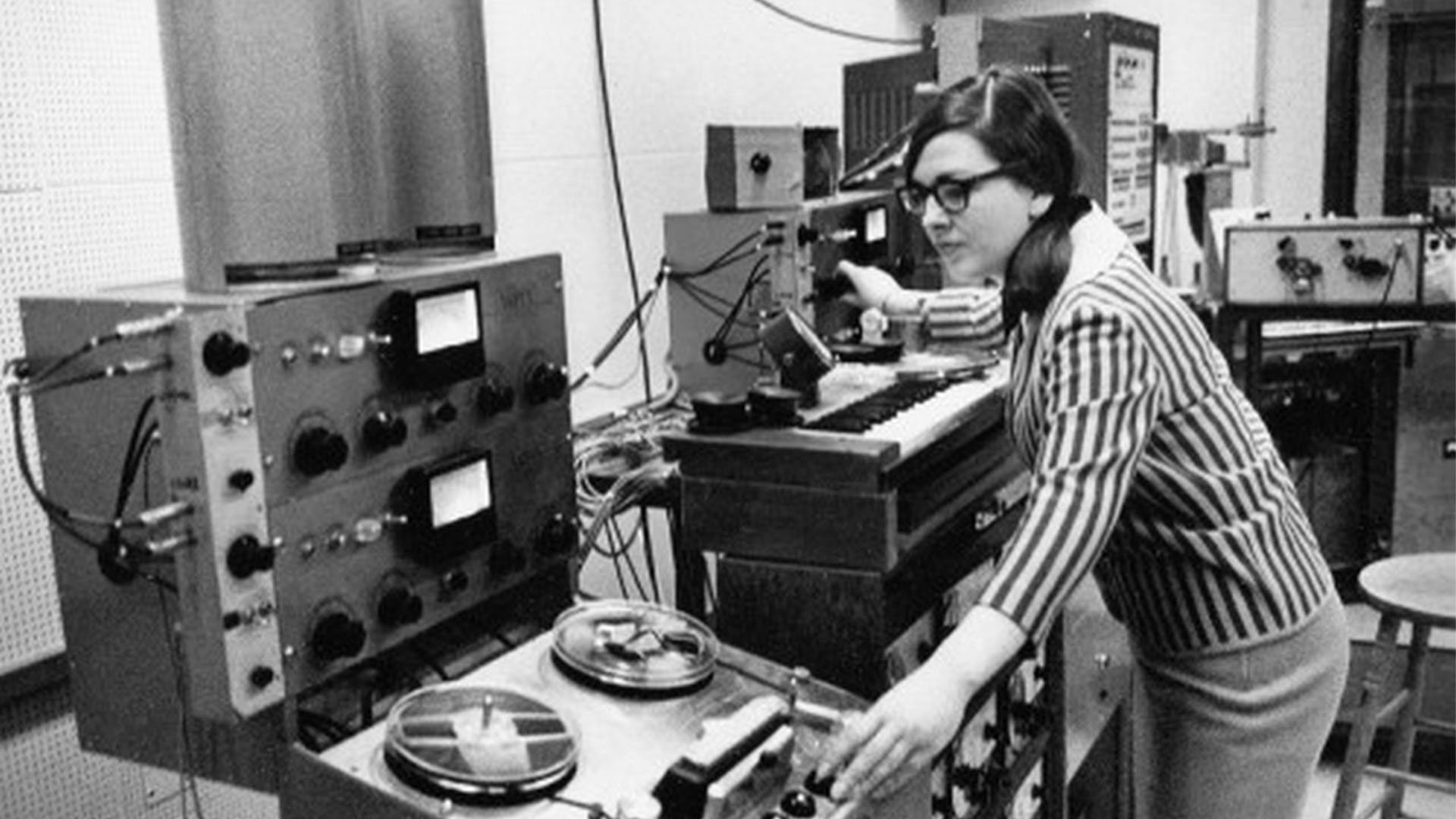
Initially housed near College and Huron streets, the studio moved in 1964 into the basement of the newly opened Edward Johnson Building, where it has remained ever since. Students who found their way down there – two levels below grade, all concrete and no windows – entered a space unlike anything else in the Faculty of Music. Sequencers and amplifiers lined the walls, and a quadraphonic playback system filled the room with sound. At the centre of it sat Le Caine’s multi-track tape machines, capable of changing the speed, pitch and combination of recorded sounds in ways that no conventional instrument at the time could.
The studio’s early directors – Myron Schaeffer, a musicologist who became an inventor almost by necessity, then composer Gustav Ciamaga – set the tone for decades of creative risk-taking.
David Jaeger was a master’s student in 1970 and recalls becoming “completely taken” with this new frontier in music-making. His first assignment, he says, was to create a composition by editing white noise.
More than any one project, though, or the unfamiliar equipment, it was the idea of taking part in the creation of a new musical “language” that fascinated him. “The whole protocol of electronic music was in the process of being invented,” he says. “There was this very open, creative atmosphere where there were no strict rules. Your imagination, your ingenuity, your wildest ideas were all par for the course.”
At the same time, students gained exposure to some of the world’s biggest names in electronic music. Dennis Patrick, a former student who later directed the studio for more than two decades, recalls visits by Le Caine and Robert Moog, the synthesizer pioneer.
Karlheinz Stockhausen, the celebrated German composer, came by on a tour stop in the early 1970s and spent an afternoon in the studio running pulses through the quadraphonic system, spinning sound around the room at changing speeds.
Patrick remembers playing some of the earliest electronic compositions for his students. “Bone-chilling: it gave you goosebumps,” he says. “And they’d ask, ‘How did they do that?’”
To many of their peers, the studio occupied a fringe of the musical world. Some found its work fascinating; others thought it was simply too strange, too “out there.” Did anyone question whether it was music at all? “From time to time,” says Jaeger. “But we didn’t care.”
The host of a CBC arts program who had interviewed Walter and two other panelists from the studio in 1963 wasn’t sure who would want to listen to electronic music – or how it would be used. He suggested it might find an audience as the soundtrack to a science-fiction film or television drama.
One of the panelists, Prof. Harvey Olnick, disagreed. To him, electronic music was simply another form of music: some of it would move listeners and some wouldn’t, though he acknowledged it might take time for audiences to adjust to its novel sounds.
History proved Olnick right. Before long, computers entered the picture and, in 1975, composer Norma Beecroft, a former student who went on to a distinguished career in composition and broadcasting, returned to U of T’s electronic music studio on a CBC commission to create Piece for Bob. The work brought together live instruments with the still-emerging possibilities of computer-generated sound, using a program created by David Jaeger, the former student.
By the early 1980s, synthesizer-driven pop music was filling the charts across North America and Europe – evidence of just how far the sounds being pioneered in studios like U of T’s had travelled.
***
Several decades on, the studio remains in the same location, though recently renovated and re-equipped with the latest technology. In the early years, an electronic performance meant pressing play on a prerecorded track. Today’s students create works in which live performers interact with technology in real time – their gestures controlling sound, their instruments processed on the fly and the boundary between musical performance and sound installation deliberately blurred.
The students also now come from a far wider range of musical backgrounds than the small cohort of the early days. The facility runs at full capacity – booked from seven in the morning until eleven at night, every day of the week, says Ryan McClelland, dean of the Faculty of Music. But the spirit, he observes, remains much the same. “There is still this sense of pushing the boundaries of what music is.”