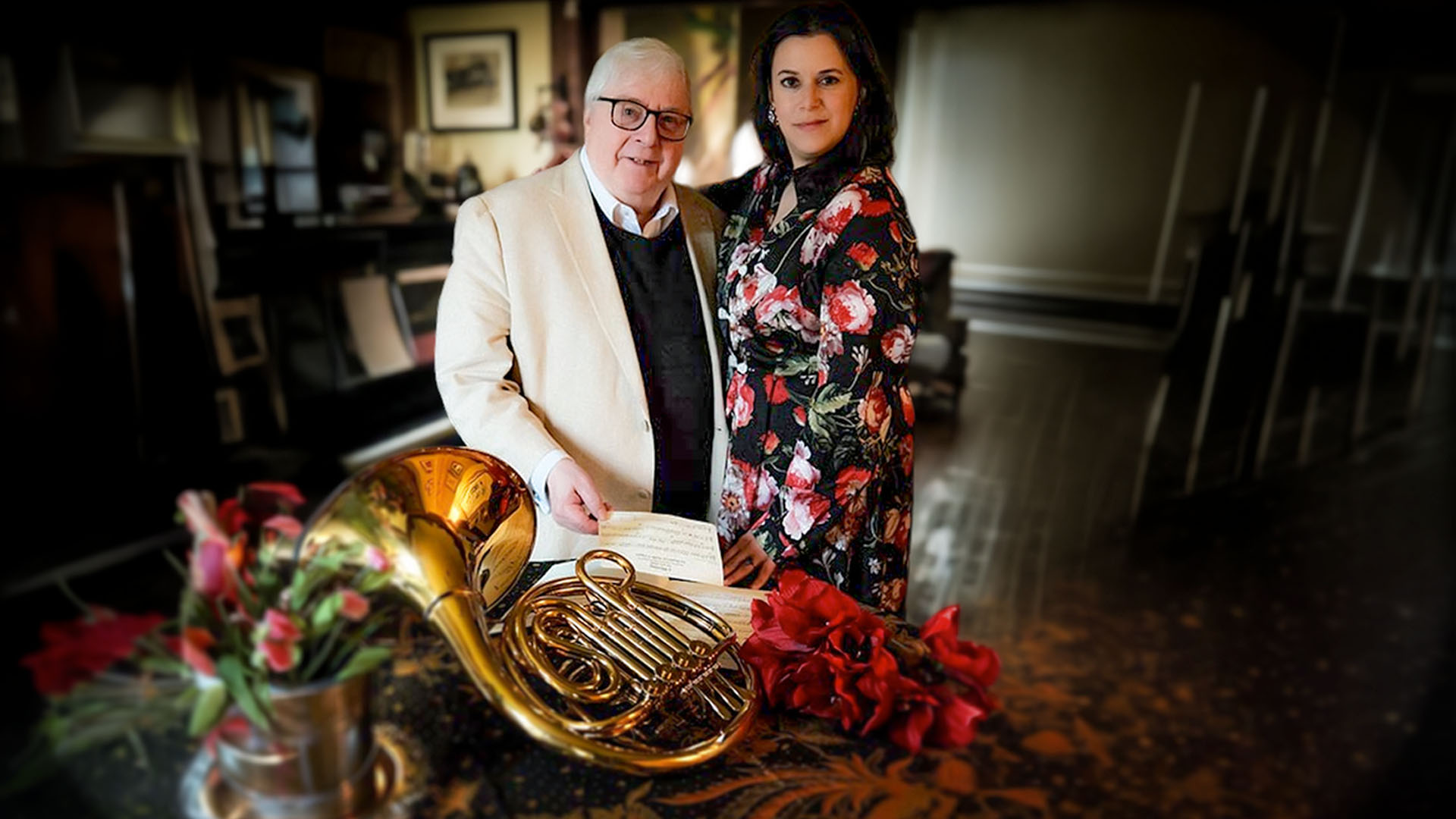
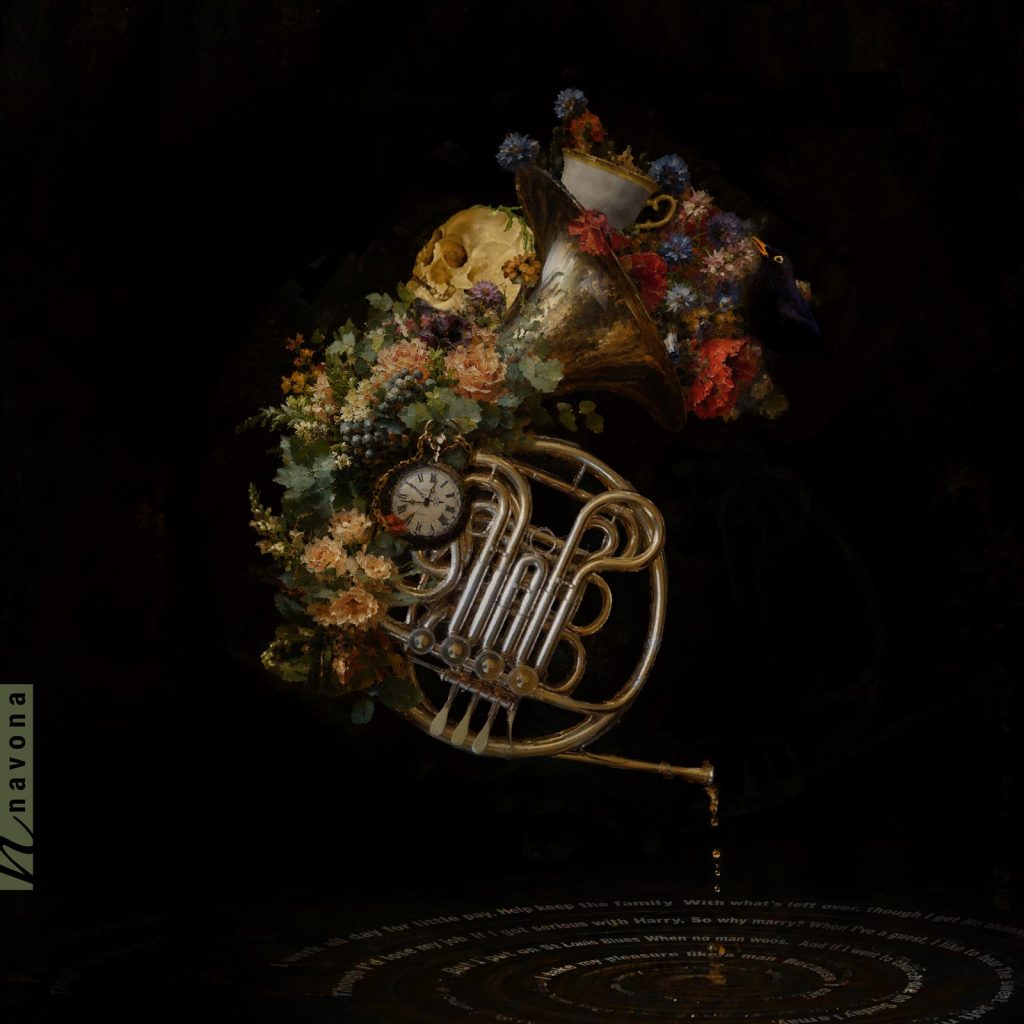
On September 29, 2026, The Toronto classical blog, Ludwig Van published an interview in which Olivia Esther (horn soloist) and David Jaeger spoke with Anya Wasserman about the upcoming album, The Horn Speaks.
The Horn Speaks is a new album that combines the talents of Canadian-Portuguese hornist Olivia Esther and Canadian composer David Jaeger. The album was released on the Navona Records label on October 9, 2026.
It also features the contributions of soprano Sara Schabas, hornist Victor Prado, pianist Stephanie Chua, and violinist Joyce Lai. The horn is an unusual focus for an entire album.
Olivia Esther & David Jaeger: The Interview
The album is the result of a collaborative musical relationship.
“It’s been a six year relationship,” says Jaeger.
It began with David listening to a CD that Olivia performed on.
“As I often do, when I’m listening to music, I make a note of the parts of the music that are exceptional.” There were several horn solos on the album. “I was just remarking, who is playing these gorgeous horn solos in this piece? The horn solos just leapt out and just declared themselves as exceptional horn playing.”
Jaeger approached Olivia by sending her a piece for the French horn.
“She was interested,” he said. “She actually wrote back and she said, if you transpose this melody up one semitone, it will go through much more of the horn tubing, and sound much fuller.”
Olivia wasn’t very familiar with Jaeger’s work at the time.
“It’s a good story because it immediately dealt with musical details and with, call it finer points of the craft. What I discovered after a few of these exchanges, when she would play for me, she played in this very nuanced and expressive way, very with great depth of interpretation. And I just thought, this is my kind of player,” he says. “These are the types of musicians that I live for. And so it just went from there, didn’t it, Olivia?”
“It did,” Esther agrees.
Jaeger was at a stage in his career where he was branching out in new directions.
“When I restarted my creative life after 40 years at CBC Radio, I did a little self-analysis,” Jaeger explains. “I said, I’ve done electronics, I’ve done modernism, I’ve done complexity.”
He looked for new avenues to explore.
“One thing I think I’ve never really applied myself 100% to is pure melody, and so I thought, I should just focus on melody. I started writing first for solo instruments, but not long after that for solo voices,” he continues.
“When you write for solo voice, of course, vocalese gets you in the door, but not very far in. You’re going to need some words. And I was very. I lucked out by meeting a soprano, Christina Haldane, who I learned was the daughter of one of England and English Canada’s great lyrical poets, the late Sean Haldane, who was happy to have me try my hand setting his words for his daughter,” he says.
“I was surprised to learn nobody had ever written a song for Christina Haldane, and secondly, nobody had ever thought to set the words of her father for her. I found that his poetry was innately musical. And so I started on this path of writing, concentrating on pure melody. By the time I discovered Olivia, I had already kind of accumulated a kind of a critical mass of a stockpile, as it were, of melodies. And based on not only Sean Haldane’s poetry, but more to the point, Sean introduced me to the Scottish poet David Cameron. I just connected with David like a house on fire.”
It led to more melodies based on poetry.
“I’ve probably set between 60 and 70 of David’s poems by now, and many of them became material for the horn. And actually, my practice at the moment, ever since then, has been pretty much text-based ever since I made that decision.”
As David points out, using poetry as a basis helps to determine not only the melody, but the interpretation of the music.
“When David reached out to me I really thought this must be a mistake,” Olivia says. “I have known about David Jeager through other mutual friends who had worked with him in the past, [like] Carol Gimbel,” she explains.
“I was a little bit floored and at the same time tickled.”
They worked together on shaping the music Jaeger had composed. “I think one of your questions was, does this fit with the horn?” she recalls David asking. “Is this something that could be played? I think that it cemented our collaborative relationship. As I got going and learning how David works, and also just the joy and the curiosity that he brings to his work, it really spoke to me,” she says.
“I found immediately that we did speak the same language.”
When she learned that the music was based on poetry, she asked to see the individual poems. “That really brought us together as well.” That was about six years ago. “And we’ve been going ever since.”
Jaeger valued her input as well as her interpretive skills. “I like to say in my 40 years as a music producer, if I’ve learned one thing, it’s the value that the interpreter brings to the game. You know, the dots on the page aren’t music until she lays hands on them and breathes life into them, and it’s just so wonderful.”
It led to dual credits as co-producers of the album. “It was a real true joint project. We’ve shared a lot of tears, a lot of laughter, a lot of just fun times in the kitchen, practicing and thinking and dreaming.”
Visit Ludwigvan at Classicalfm.ca to read the rest of the interview.